
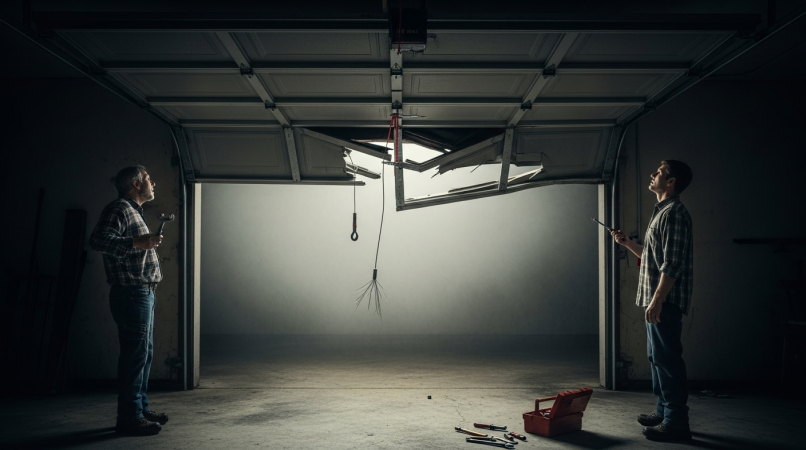
Do It Yourself or Do It Yourself? 5 garage door repairs that are extremely dangerous to do yourself.
In today's digital era, millions of tutorial videos come in front of us when we search for "How to" or "How to do." YouTube and DIY (Do It Yourself) forums have made us believe that with a little willpower and some tools, we can repair anything in the house. From installing tiles to repairing the engine of the car - everything is possible.
So, when your garage door suddenly closes with a bang, or gets stuck on one side, the first thought comes: "I can fix it myself! " You may think, "Some money will be saved," or "It's just a simple mechanical thing. "
But here's the biggest mistake of all. Your garage door is not like any other piece of equipment in your home. It is the largest and heaviest moving object in your house. It is a complex system, which works by combining springs, cables and powerful motors under extreme tension.
At AutoDoorExperts, we believe in empowering our customers. We want you to understand your systems. But as a responsible expert, our first and foremost responsibility is to ensure your safety.
The truth is, repairing a garage door is one of the most dangerous DIY projects in the home. A slight mistake will not only cause greater damage to your door, but it can also cause serious physical injury, even death.
In this article, we'll show you that fine line. We'll discuss which things you can do yourself safely (such as general maintenance) and which 5 repairs you should never, ever try on your own. This guide is not to save your money, but to save your life.
Part 1: Safe Zones - Things You Can Do Yourself
We're not here to scare you. There are some basic maintenance of the garage door that you can do yourself. These actions will extend the life of your door and prevent minor problems from becoming major ones.
1.1. Regular visual inspection (visual inspection)
Once a month, look and listen carefully when opening and closing your garage door.
- What will you see? Are the tracks parallel? Are the rollers moving smoothly? Is there any rust or fraying in the cables? Are there any broken parts around the spring?
- What do you hear? Are there any noises outside the normal range, such as sneezing, coughing, or wheezing?
1.2. Keeping clean
In a dusty city like Riyadh (especially if you live in the service area of AutodorExperts), dirt, sand and debris can quickly accumulate on garage door tracks.
Clean the inside of the track with a vacuum cleaner.
Wipe the door panels and safety sensors with a wet cloth. WARNING: Do not bend the track to remove solid dirt that has accumulated on the track.
1.3. Remote control and keypad battery change
If your remote doesn't work, the first and easiest solution is to check the battery. It is as safe as any electronic device.
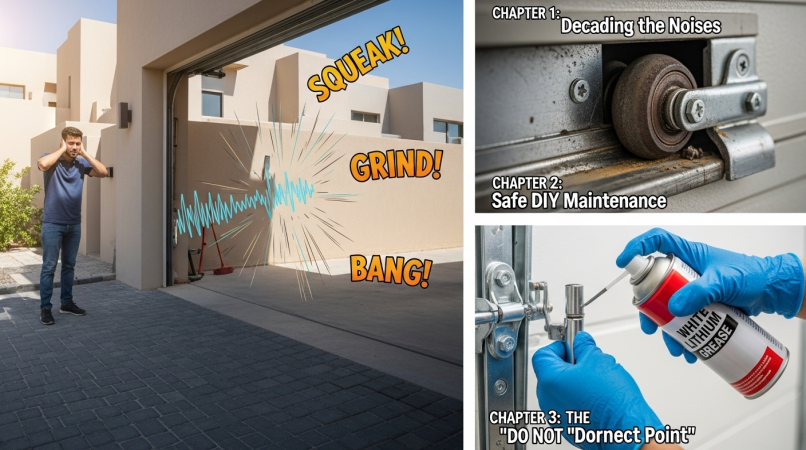
1.4. General lubrication (in the right way)
Garage doors require lubrication to keep the moving parts smooth. But here's where a lot of people go wrong.
- What to use: Use lithium-based grease or silicone spray made specifically for garage doors.
- Do not use: WD-40. It's not oil, it's a solvent that washes away grease and attracts more dust.
- Where to lubricate: metallic roller (if you don't have a nylon roller) on the hinges or hinge and spring (to prevent rust).
- Where not to: Don't ever lubricate the door track. Rollers are supposed to "roll" on the track, not "slide." If oil is poured on the track, it will slip the roller and create a muddy situation by accumulating dust.
1.5. The safety reversal test
This should be done every month. It's important to check that your door's safety sensors (the two small "eyes" that line both sides of the doorway) are working properly.
Test 1 (Object Test) Place a cardboard box or a piece of wood (not brick or anything hard) right in the middle of the door. At this point, press the Close button. The door should automatically open in the opposite direction as soon as it touches the object.
Test 2 (Wave Test) Press the door close button and when the door comes down, pass the beam of the sensor through your foot (without leaving it under the door). The door should open in the opposite direction.
If these tests fail, your sensors are likely out of alignment or have accumulated dirt. You can remove the lens of the sensor with a soft cloth. If it doesn't work, call a professional.
Part 2: The Danger Zone - Don't Try to Do These 5 Repairs Yourself
Now we get into the main topic. The following actions are not ordinary "fixes." These are high-risk mechanical or electrical jobs that require specialized training, specialized equipment, and in-depth knowledge of the system.
Danger 1: Replacing or repairing the garage door spring (torsion or extension)
It's number one on the list and for good reason. The garage door spring is the heart of the whole system and it is the most dangerous part.
Why it is dangerous?
The weight of your garage door can range from 150 to 250 kg or more. The garage door opener (motor) does not lift this weight; it simply "guides" the door. The spring does the actual weight lifting.
When the springs are "loaded" or tensioned, they literally hold a bomb of enormous power.
Torsion spring These large springs are usually mounted on a metal shaft just above the door. They are tightened by winding them with a special tool called "Winding Bars." If this spring breaks or you try to open it with the wrong tool, then:
- The spring can explode and throw off pieces of metal.
- The tool you're using (such as a screwdriver or wrench) can slip out of your hand and hit your face, head, or chest. This injury can be serious.
- The cable connected to the spring can be knocked out.
Extension spring these springs are on both sides of the door, parallel to the track. They expand when the door is closed. If one of them breaks, it can snap like a rubber band and hit your car, wall, or your body. That's why professionals always install a "safety cable" through this spring, which prevents the spring from being knocked out even if it breaks.
The general results of DIY efforts:
- Severe Injury: Broken wrists, loss of a finger, head injury, or blindness are very common occurrences.
- Incorrect Parts: Each door requires specific springs for its weight and size. Buying the wrong spring online (which looks the same) will ruin the balance of your door.
- Unfinished work: Many homeowners realize after opening the spring that they don't have the right tools or energy to put it back on, leaving their garage door stuck in the open and the house unsafe.
How does AutoDoorExperts do it?
Our technicians first identify the correct torsion or extension spring according to the weight and size of the door. They safely release the tension of the old spring by using a "winding bar" of the right length and strength. After installing the new spring, they perfectly "balance" or balance the door. A properly balanced door will stay in place even if it is left half open. This reduces the pressure on your opener and increases the life of the door.
Danger 2: Broken or frayed lift cables.
The lift cables are the two wires that start from the bottom bracket of the door and wrap around the drum at the top and connect to the spring system.
Why it is dangerous?
These cables are directly connected to the high-pressure spring. They transfer the power of the spring to the door.
- Instant fall: If one cable is torn, the entire weight of the door falls on the other cable, which can not withstand even that. As a result, the door of 150-250 kg can be slammed down without any hindrance. If someone or something (your car) is under the door at that moment, the consequences will be terrible.
- Sharp and high-pressure: Trying to catch a torn cable means playing with sharp metal wires and high tension. If the cable slips or runs out of brackets, it can strike like a whip, causing a deep groan.
- Imbalance: Even if one is only slightly worn, the door loses balance, which can cause the door to tilt to one side and get stuck in the track (which leads us to danger number 4).
The general results of DIY efforts:
- Loss of finger: Many people grind their finger between the drum and the shaft when trying to put the cable back on the drum.
- Incomplete Repair: Replacing a cable does not mean that the system is fixed. Both cables had to be replaced together and the door had to be re-leveled and the spring re-tensioned. It's a complex process.
How does AutoDoorExperts do it?
We always replace two cables together, even if there is only one torn. Because one tear means that the other has been used the same amount and will tear soon. Our technicians first secure the system by completely releasing the tension of the spring. They then install the new, correct gauge cable, check the drums, and make sure that the tension of both cables is equal, so that the door moves in a perfectly straight line.
Danger 3: electrical problems with the garage door opener (motor)
Many people think, "This is a plug-in device, I can fix its wiring. " But the garage door opener is not like a normal fan or light.
Why it is dangerous?
- The electric shock opener contains high-voltage wiring and capacitor. These capacitors can hold a charge for a long time even after the plug is opened. A misaligned wire can cause a serious electrical shock.
- Fire Hazard: Wrong wiring, plugging in, or using the wrong fuse can cause a short circuit, which can cause a fire in your garage - especially when you're not home.
- Destroying the logic board: Modern openers have sensitive logic boards (computer chips). A little static electricity or faulty wiring can permanently damage this board, causing a minor repair to turn into a major replacement.
- Destroying the safety feature: Setting the "Force Limit" and "Travel Limit" of the opener is a delicate task. If you set it incorrectly, then:
- The door will not open upside down even if it is hit by an obstacle (such as a child or pet).
- The door will close with excessive force, which can cause the door panel to burst or the gear of the opener to be destroyed.
The general results of DIY efforts:
- Burning the entire logic board while solving a small sensor problem.
- The door does not close properly due to the wrong setting, which puts the safety of your home at risk.
- risk of electric shock or fire.
How does AutoDoorExperts do it?
Our technicians are trained on the complex wiring and logic boards of different brands (such as LiftMaster, Genie). They can accurately diagnose the problem - is it a problem with the wiring, logic board, motor, or capacitor? They meticulously calibrate the safety sensor and force limit after repairing or replacing the opener, so that it is 100% safe for your family.
Danger 4: bent or off-track rollers and tracks
Maybe you accidentally pushed a little on the door while inserting the car, and a few rollers fell off the track. Your first instinct may be to straighten the track with a hammer or push the rollers back in.
Why it is dangerous?
- The main reason is unknown: a door usually does not fall out of the track without a reason. This may be due to a broken cable, a broken roller, or a door imbalance. If you just return the roller to the track, you are not solving the original problem.
- Risk of immediate fall: When the roller is off the track, there is no support for that part of the door. When you try to move it, the rest of the rollers can also come off and the whole door can collapse on you.
- Use of hammer: If the track is hit by a hammer, it becomes more deformed. Instead of a smooth track, you create a smooth, weak track, which will jam the rollers even more in the future.
- Damage to the panel: Forcing a bent door to fluctuate can cause the door panels to permanently bend or the hinges to break.
The general results of DIY efforts:
- Turning a small track repair problem into a full door panel replacement problem.
- Throw it on yourself or the car when trying to fix the door.
- Lock the door so that it can no longer be opened or closed.
How does AutoDoorExperts do it?
When a door is off-track, we first securely fasten the door with a "brace" or support to prevent it from moving. Then we figure out why it went off-track. Can we just see a crack? A broken roller? We solved the main problem. Next, we use special tools to restore the track to its original shape or (if too damaged) replace the section. Finally, we check each roller and make sure that the door is running smoothly and straight.
Danger 5: Replacing Bottom Brackets and Fixtures
This is probably the least known but most serious danger on the list. The bottom bracket is the small metal holder that is just below the door, on both sides. It is in this bracket that the lift cable (which is connected to the spring) is attached.
Why it is dangerous?
The bottom bracket is literally the highest point of tension or pressure in the entire garage door system. All the power of the spring is concentrated in the bottom bracket through this cable.
It is always under extreme pressure, even when the door is closed.
If you try to open the bolts of the bottom bracket without completely releasing the tension of the spring, it is difficult to imagine what will happen. The bracket will pop out like a bullet. It can break down walls. If it hits your body, the result will be tragic and permanent.
In the industry, the bottom bracket is called "the death trap." Numerous experienced DIY enthusiasts have been permanently crippled or killed trying to repair this one part.
The general results of DIY efforts:
- serious, life-threatening injuries. There are no minor accidents.
- The door collapsed uncontrollably as the tension in the cable was suddenly released.
Services>
How does AutoDoorExperts do it?
There's no easy way out. This is a "non-negotiable" protocol for our technicians. Before you get your hands on the bottom bracket, you need to completely and professionally release the tension of the system (which is related to our No. 1 danger). This is a multi-step process that can only be done safely by those who are trained. Your safety is the first priority for us.
Part 3: The Value of a Professional
Now you may be thinking, "Then what I can do? " The answer is simple: whenever the problem is something more complicated than cleaning or changing the battery, call a professional.
The tens of thousands of money you're trying to save by DIYing is nothing compared to the cost of a hospital bill or buying a new garage door in one wrong move.
1. Safety and peace of mind
Having a technician from AutoDoorExperts come to your home means you're getting someone who's done this dangerous job hundreds of times. They know the safety protocols. You and your family will be safe, and the job will be done right the first time. This peace of mind is not worth it.
2. The Right Tools
We don't work with a wrench or hammer. We have properly sized "winding bars" to wind the torsion spring, gauges to measure tension, and specialized tools to straighten the track. It is impossible to do without the right tools.
3. Accurate diagnosis
is knocking on your door. You may think you need to lubricate. But a professional will come and see that the sound is actually coming from a broken roller or a worn out bearing. We repair not only the symptoms, but also the root cause of the disease.
4. Warranty and Guarantee
If you put a spring on yourself and it breaks after a month, then your entire money is wasted. We offer a warranty on all parts and repairs. If there is a problems after our works, we are responsible to come back and solve it again.
5. Long-Term Savings
A professional repair can extend the life of your garage door system for many years. On the other hand, an incorrect DIY repair often causes additional stress on other parts of the system (such as the opener), resulting in the need for larger and more expensive repairs in the future.
6. Local Experience (Riyadh Context)
AutoDoorExperts operates in the markets of Riyadh, Jeddah and Dammam. We know how the weather here - the intense heat and dust - affects the parts of the garage door. We use parts and lubricants that can withstand this hostile environment.
Conclusion: Be smart, be safe.
Your garage door is a wonderful tool that makes your life easier. But it needs to be treated with care and respect.
Be sure to do the small things yourself, such as cleaning, changing batteries, and checking sensors. But whenever you're faced with a broken spring, torn cables, electrical problems, or a door that falls off the track - stop. Put down the toolbox and pick up your phone.
It's not as cheap as risking your safety, your time, and the safety of your home.
Are you having problems with your garage door? Don't take risk. Call us today [Your Phone Number] or book a service on our website [www.autodoorexperts.com] for a trained, reliable and secure service from AutoDoorExperts. We'll open your door quickly and safely.
 WhatsApp Us